Governance
Leadership ownership, accountability and clear decision rights.
 Psychological Health & Safety
PHSMS™ — Psychological Health & Safety Management System
PHSMS™ is a practical management system that helps organizations prevent psychological harm, identify psychosocial risks early, respond consistently, support recovery and continuously improve.
WHAT IT IS
PHSMS™ works with—not against—your existing occupational health and safety and people systems. It widens what those systems can see and gives your organization the governance, processes and capability to act.
SYSTEM ARCHITECTURE
The five operating standards are held together by six organizational enablers. Select the full diagram to examine the architecture in detail.
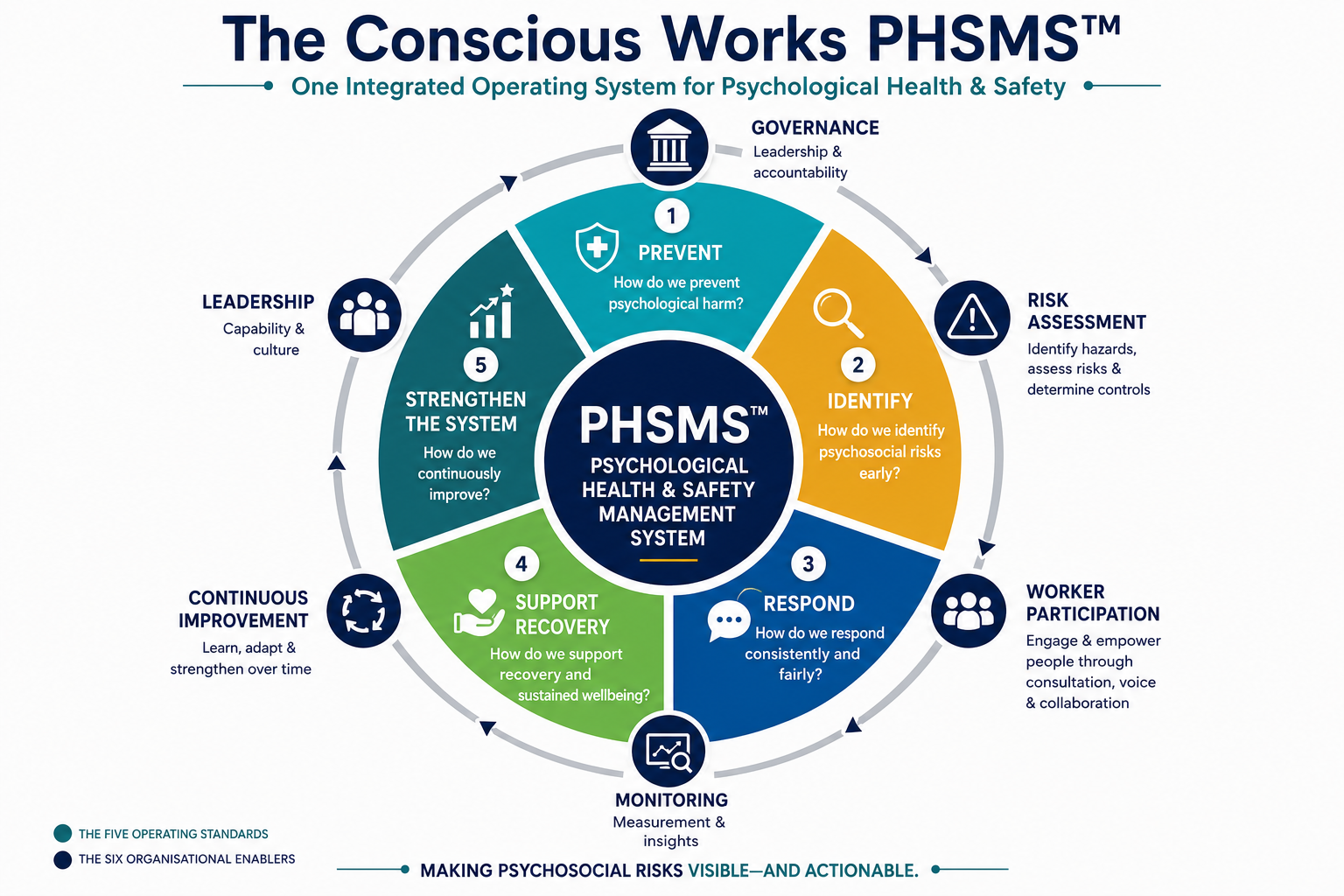 Open full diagram ↗
One integrated operating system for psychological health and safety.
THE FIVE OPERATING STANDARDS
Each standard answers one essential management question and builds a specific organizational capability.
Build healthier work by identifying hazards, improving work design and putting effective controls in place before harm occurs.
Connect workforce signals so emerging pressure points become visible early enough for informed action.
Give people clear roles, practical tools and reliable pathways for responding safely, fairly and within their role.
Create consistent support for recovery, workplace adjustments, return-to-work and sustainable reintegration.
Use evidence, review and clear ownership to understand what is working and continuously strengthen the system.
THE SIX ORGANIZATIONAL ENABLERS
A framework does not become a system until leadership, participation, evidence and accountability hold it together.
Leadership ownership, accountability and clear decision rights.
Identify hazards, assess psychosocial risks and determine proportionate controls.
Engage people through consultation, voice and meaningful collaboration.
Use measures, workforce signals and insights to track system performance.
Learn, adapt and strengthen the system over time.
Build the capability and culture required to make the system work in practice.
WHAT YOUR ORGANIZATION RECEIVES
The exact scope is shaped around your context, maturity and existing systems. These are the core building blocks.
Clear roles, accountabilities, decision rights and oversight arrangements.
Assessment, risk registers, control planning and regular risk review.
Response tools, escalation, referral, confidentiality and reintegration pathways.
Practical resources for leaders, managers, response roles and worker participation.
KPIs, dashboards, review, assurance and a structured improvement register.
IMPLEMENTATION JOURNEY
PHSMS™ is implemented as an organizational change process—not handed over as a static toolkit.
Make psychosocial risks, existing strengths and system gaps visible.
Define the right governance, standards, controls and operating architecture.
Create the tools, roles, processes and organizational capability.
Embed the system into everyday leadership, management and work practices.
Review performance, learn from experience and strengthen the system.
WHAT CHANGES
BeforeReactive decisions, scattered programs, unclear accountability and limited evidence.
AfterVisible risks, clear ownership, proportionate controls, consistent response and measurable learning.
01Earlier risk visibility
02Clearer leadership accountability
03More consistent response and recovery
04Better evidence for decisions
A focused consultation will help us understand your risks, priorities and current capability.